
Intel's initial mobile processing technology designed specifically for notebooks to deliver great mobile performance and low power enhancements.

Unlike Dell's traditionall black or grey color scheme, this laptop case featured a silver, white, and black design. Measuring under 2 inches thick and having a 12.1-inch TrueLife screen, the laptop was a departure from previous versions. However, without the extended battery, life was short, and the 12.1-inch screen was a dust magnet. The base model had a 1.5 GHz Pentium M processor, 256 MB (256 MiB) of RAM, a 30 GB (30 billion bytes) HD, and a DVD optical drive.
Many users report two major flaws with the 700m: the audio-input quality, where audio recording using the audio input jack is nearly impossible (reparable with a simple driver update),[6] and severed speaker wires caused from the normal use of opening and closing the screen.[7]


 For mobile platforms the Intel® Core™ Solo processor represents the next generation in processor innovation.
 Based on Intel® architecture, the Intel® EP80579 Integrated Processor product line is the first in a series of breakthrough system on-a-chip (SOC) processors, delivering excellent performance-per-watt for small form factor designs.
 This fully compatible product line (Intel EP80579 Integrated Processor and Intel® EP80579 Integrated Processor with Intel® QuickAssist Technology) provides an outstanding combination of performance, power efficiency, footprint savings and cost-effectiveness compared to discrete, multi-chip solutions.
These integrated processors are ideal for small-to-medium business (SMB) and enterprise security and communications appliances (including VPN/firewall and unified threat management), transaction terminals, interactive clients, print and imaging applications, wireless and WiMax access applications, SMB and home network attached storage, converged IP PBX solutions, converged access platforms, IP media servers, VoIP gateways and industrial automation applications.
Featuring embedded lifecycle support, the Intel Atom processors are ideal for many embedded market segments such as in-vehicle infotainment, medical, interactive client (kiosks, point-of-sale terminals), gaming and industrial control. It remains software compatible with previous 32-bit Intel® architecture and complementary silicon.
These single-core processors are validated with the Intel® System Controller Hub (SCH) US15W, which integrates a graphics memory controller hub and an I/O controller hub into one small 22x22 mm package. This low-power platform has a combined thermal design power under five watts.
 The Intel® Atom™ processor N270Ω, implemented in 45nm technology, is power-optimized and delivers robust performance-per-watt for cost-effective embedded solutions. Featuring extended lifecycle support, this processor offers an excellent solution for embedded market segments such as digital signage, interactive clients (kiosks, point-of-sale terminals), thin clients, digital security, residential gateways, print imaging, and commercial and industrial control. The processor remains software compatible with previous 32-bit Intel® architecture and complementary silicon.
 This single-core processor is validated with the mobile Intel® 945GSE Express Chipset, consisting of the Intel® 82945GSE Graphics Memory Controller Hub and Intel® I/O Controller Hub 7-M. The chipset features power-efficient graphics with an integrated 32-bit 3D graphics engine based on Intel® Graphics Media Accelerator 950 architecture with SDVO, LVDS, CRT, and TV-Out display ports. It provides rich I/O capabilities and flexibility via high-bandwidth interfaces such as PCI Express,* PCI, Serial ATA, and Hi-Speed USB 2.0 connectivity.
Breakthrough performance, energy efficiency, extended lifecycle support and common socket Intel Xeon processor-based systems make them the ideal choice for compute-intensive embedded, storage and communications applications.
Lower thermal design power (TDP) and higher Tcase temperature Intel Xeon processor options are ideal options for low power consumption and/or compliance with the AdvancedTCA* form factor and NEBS level-3 thermal specifications*.
 The Intel® Xeon® processor LV and Intel® Xeon® processor ULV are members of Intel’s growing product line of multi-core processors. Each dual-core processor combines the benefits of two high-performance execution cores with intelligent power management features to deliver significantly greater performance-per-watt over previous single-core Intel Xeon processor-based platforms. The dual-core/dual-processor capabilities are ideal for a wide range of low-power communications and embedded applications.
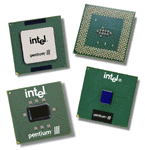 The Pentium® III processor is ideal for high performance applied computing. It supports highend communications, transaction terminal, and industrial automation applications. While incorporating new features and improvements, the Pentium III processor remains software compatible with previous members of the Intel microprocessor family.
 For cutting-edge nomads seeking the best pocketable Internet experience, Intel® Centrino® Atom™ processor technology unleashes the freedom and flexibility of Mobile Internet Devices (MIDs) enabling you to enjoy your entertainment or access the full Internet on the go.¹

 The Intel® Celeron® M processor family is the next generation of mobile value processors, providing exceptional performance and value combined with low power for thermally sensitive embedded and communications applications. These processors offer ideal solutions for small-to-medium business and enterprise communications, storage appliances, and value-oriented embedded devices like Point Of Sale, kiosks and ATMs.
 The Intel® Atom™ processor is Intel's smallest processor, built with the world's smallest transistors and manufactured on Intel's industry-leading 45nm Hi-k Metal Gate technology. The Intel Atom processor was purpose-built for simple, affordable, netbooks and nettops.
 Intel Atom processor-based netbooks and nettops offer both an easy-to-use mobile device with simple interfaces and targeted performance for a good online experience. They are rugged and compact in design, and offer the freedom and flexibility of wireless connectivity¹.
Great for Internet, these devices are an affordable option for education, photo and video viewing, social networking, voice over IP, e-mail, messaging, browsing, and numerous other Internet activities and basic applications.

 |
| Industry-leading performance, flexibility, and ease-of-use |
 From point-of-sale (POS) terminals and retail kiosks to advanced networking equipment, Pentium® processors with MMX™ technology enable developers of embedded systems to step up to new levels of performance. To make these designs even easier and more flexible, Intel is making the performance advantages of MMX technology available at a choice of integration levels.
